
A screw turns, and something moves. At the scale of irrigation equipment, that something can be water. At the scale of a single molecule, the relationship becomes stranger: electrical current can drive rotation, and rotation can change the current.
A study published in Nature on October 22, 2026 explores that feedback in a helical molecular machine. The familiar Archimedes’ screw offers a way into the story. The experiment itself concerns electron transport, rather than lifting water.
How do you watch a molecule turn?
The researchers placed a helical organic molecule between gold electrodes under conditions close to absolute zero. As voltage was applied, repeated changes in current indicated directional rotation. Reversing the current reversed the sequence of those changes, consistent with rotation in the opposite direction.
That distinction matters: the measurement was an electrical signal used to investigate molecular motion. It was not a conventional video of a miniature mechanical screw.
Motion changes the circuit
According to the Weizmann Institute’s account, current increased by as much as a factor of 100 above a voltage threshold. The researchers’ calculations linked the jump to a transition from stepwise movement to continuous rotation. Stretching or compressing the molecule changed the threshold.
The useful idea is a feedback loop. Electrical input changes mechanical motion; mechanical motion changes electrical conduction. Treating the molecule as a motionless wire would miss part of its behavior.
A demonstration is the beginning of an engineering question
A result in a carefully controlled junction is not yet a component ready for a consumer device. To assess a future application, ask how it behaves across temperatures, how consistently junctions can be made, how long operation lasts, and how the molecule connects to a larger system.
Those questions do not diminish the discovery. They explain the distance between showing an operating principle and building a reliable machine around it.
Keep the analogy useful
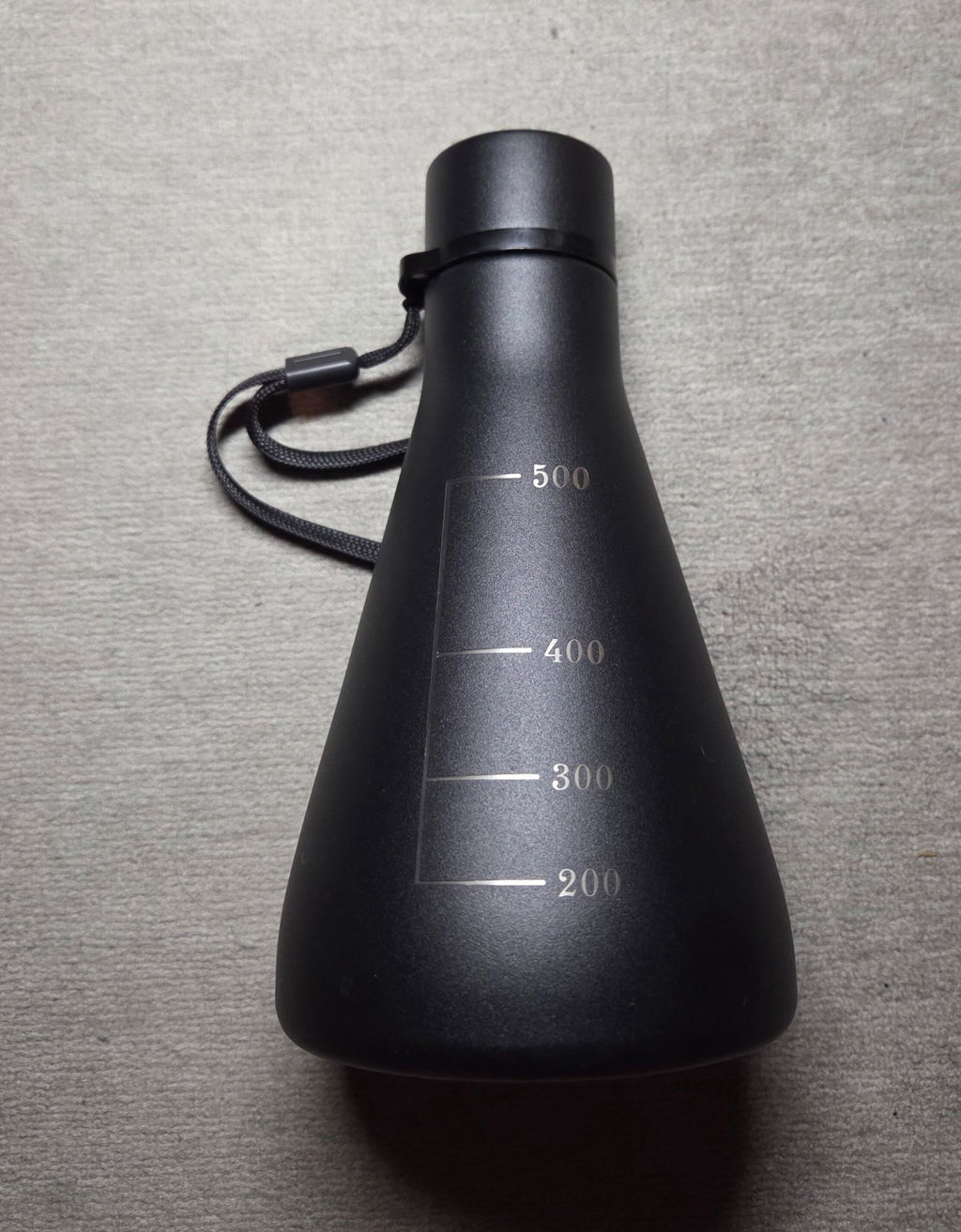
Scientific shapes give us a starting point: a helix suggests a screw; an Erlenmeyer silhouette suggests a laboratory flask. Neither resemblance tells the whole story. Our Flask Vessel borrows a familiar laboratory form for everyday drinkware. This molecular experiment borrows a familiar mechanical idea to investigate behavior at an entirely different scale.
The interesting question in both cases is what the form actually does. Here, a molecule’s movement becomes part of the circuit.