
Material names are useful shorthand. They are also incomplete descriptions. A solid object and a suspension of microscopic fragments can be made from the same polymer while presenting very different surfaces to their surroundings.
A study published in Nature on October 14, 2026, examines that distinction. Researchers from Columbia University and the University of California, Berkeley, reported chemical activity at microplastic–water interfaces. The finding gives scientists a mechanism to investigate, rather than a finished answer about everyday health risk.
The interface is part of the chemistry
The paper, “Intrinsic physicochemical activity at microplastic–water interfaces,” reports that contact between water and microplastic surfaces can generate reactive oxygen species. These include hydroxyl radicals, highly reactive species that can participate in reactions with biological molecules.
The study also reports protein aggregation and cellular damage in experimental systems. Those observations make the interface worth studying. They do not mean that a person drinking from a plastic bottle experiences the same conditions as a laboratory sample.
Why breaking something apart changes the question
As an object fragments, more surface becomes accessible relative to the amount of material. Imagine dividing a cube into smaller cubes: the total amount of material stays the same, while previously internal faces become exposed.
That geometric change helps explain why conclusions about a large plastic object cannot automatically be applied to microplastics—or the reverse. Columbia’s account of the research describes water as an active participant in the interfacial chemistry.
Berkeley’s explanation describes calculations and simulations connecting hydrophobic interfaces with electron-transfer processes. In this account, the particles are more than passive carriers: their surfaces help create conditions for chemical reactions.
A mechanism is not an exposure estimate
To turn these findings into an assessment of a particular drinking habit, researchers would need to connect several steps: which particles are released, how much someone encounters, what enters or remains in the body, and whether those exposures produce a measurable effect.
These are separate questions. A result showing what can happen under experimental conditions does not, on its own, tell us how often it happens in daily life or how large the resulting risk might be.
The FDA’s current overview identifies major gaps in measurement methods and human health evidence. Its assessment says that available evidence does not demonstrate a human health risk from the levels detected in foods. That statement is not proof that every exposure is harmless; it is a description of what the evidence presently establishes.
What this means for choosing drinkware
The study supports asking more specific material questions. It does not provide a clinical comparison of glass, steel, and plastic bottles, and it did not test The Calculated Chemist’s products.
A glass or steel body also does not describe an entire drinking system. Lids, seals, straws, coatings, the water supply, and cleaning practices still deserve attention. Switching the body material is not evidence of zero particles or a demonstrated health benefit.
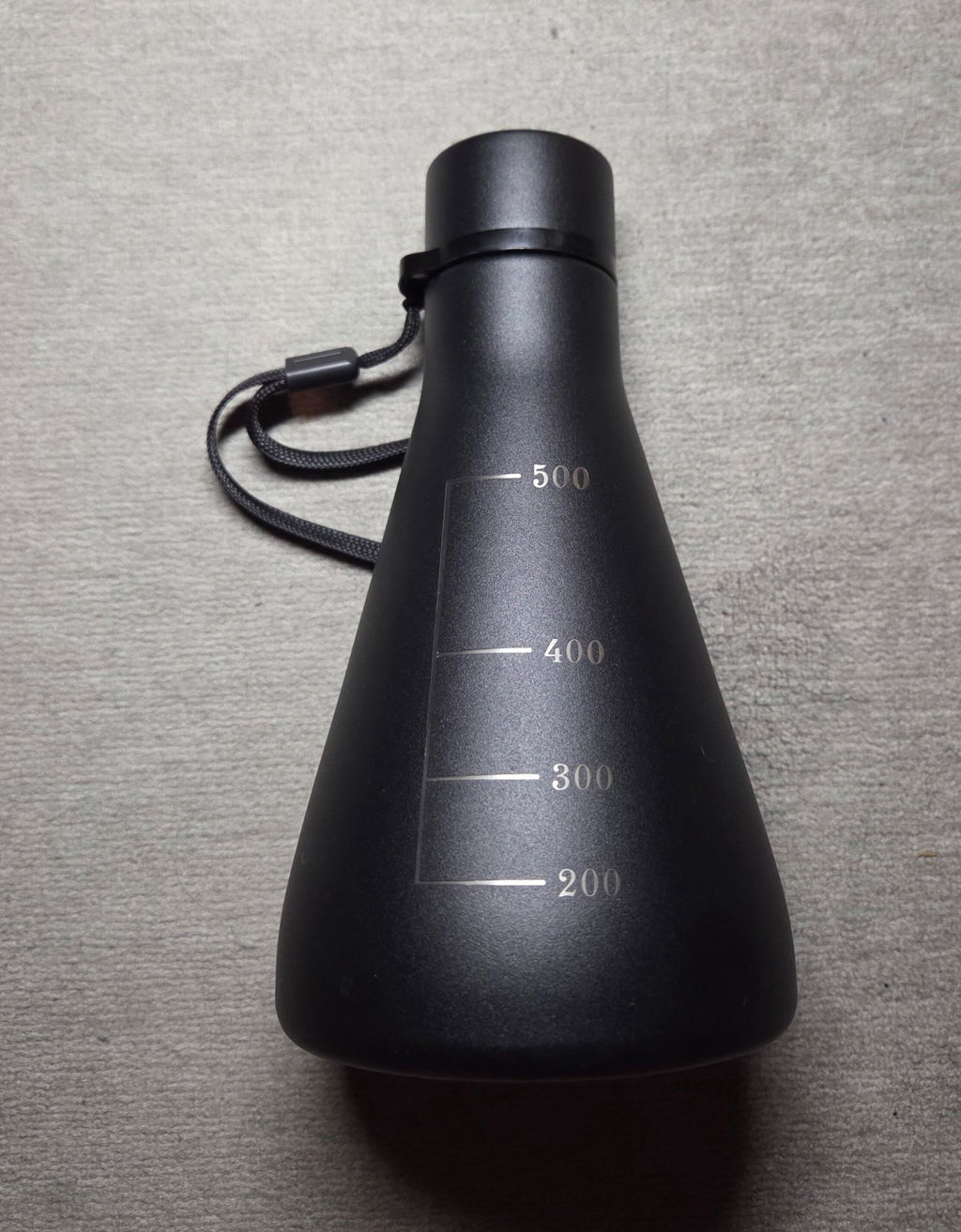
Our Flask Vessel uses a 304 stainless steel body with double-wall vacuum insulation. Those are construction choices, not a claim that the bottle prevents disease or eliminates microplastic exposure. You can examine its materials and care specifications here.
The useful change in perspective
The strongest lesson is methodological: consider size, surface, environment, and use together. “Plastic” is too broad a label to explain every behavior, just as “metal” or “glass” would be.
For everyday purchasing, that means looking for clear specifications and appropriate care instructions. For the science, it means following the next experiments without turning an important mechanism into a conclusion those experiments have not yet reached.